Knowing the margin on every watch sold
The starting point
Second-hand watches, each one unique
Ponti Collection buys and sells pre-owned watches in Geneva. Year, strap, condition, purchase price: no piece is worth exactly the same as another.
And part of the stock isn't theirs: pieces left on consignment remain the consignor's property until sold.
What it cost
Everything on paper, and no figures on the stock
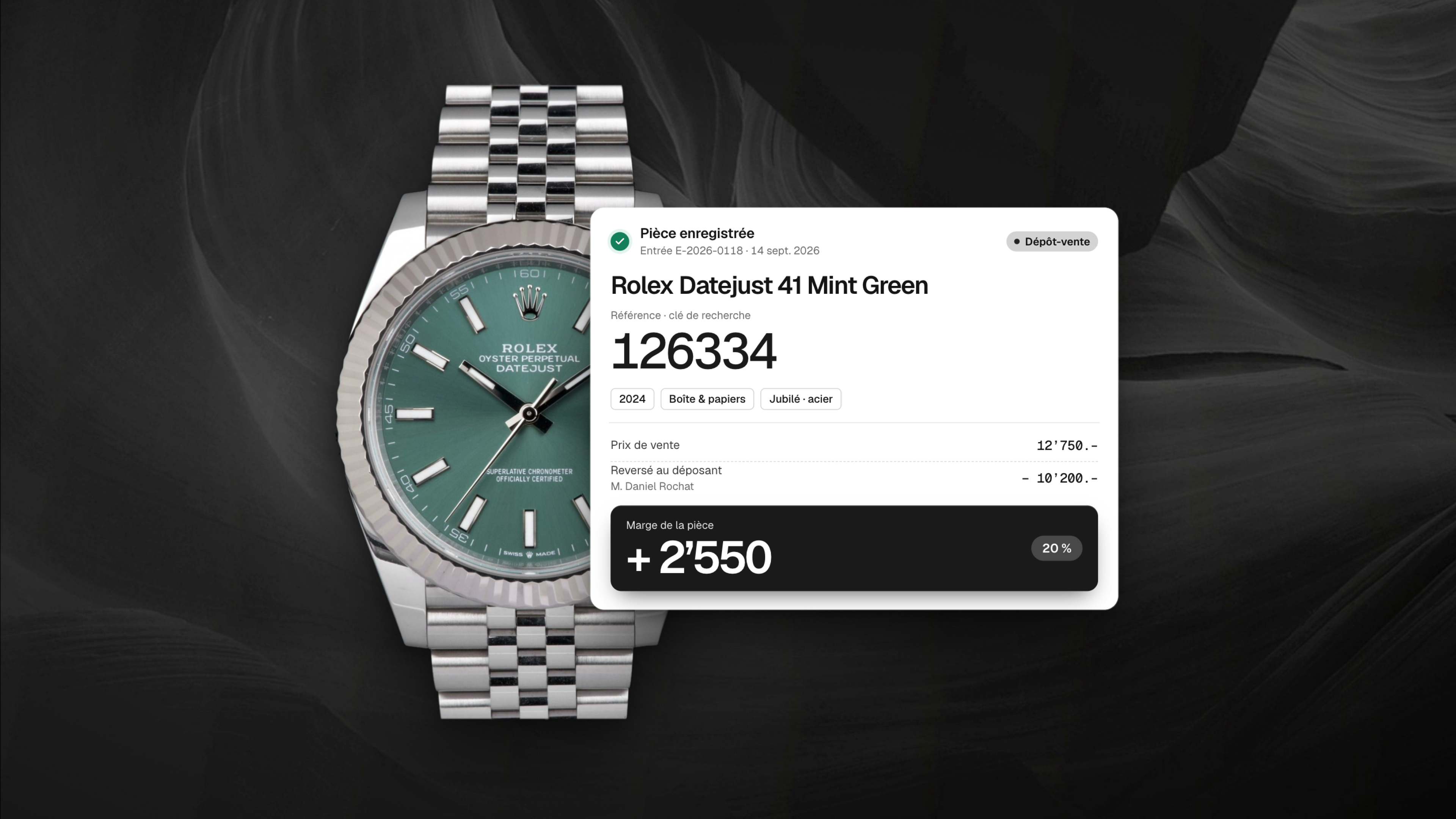
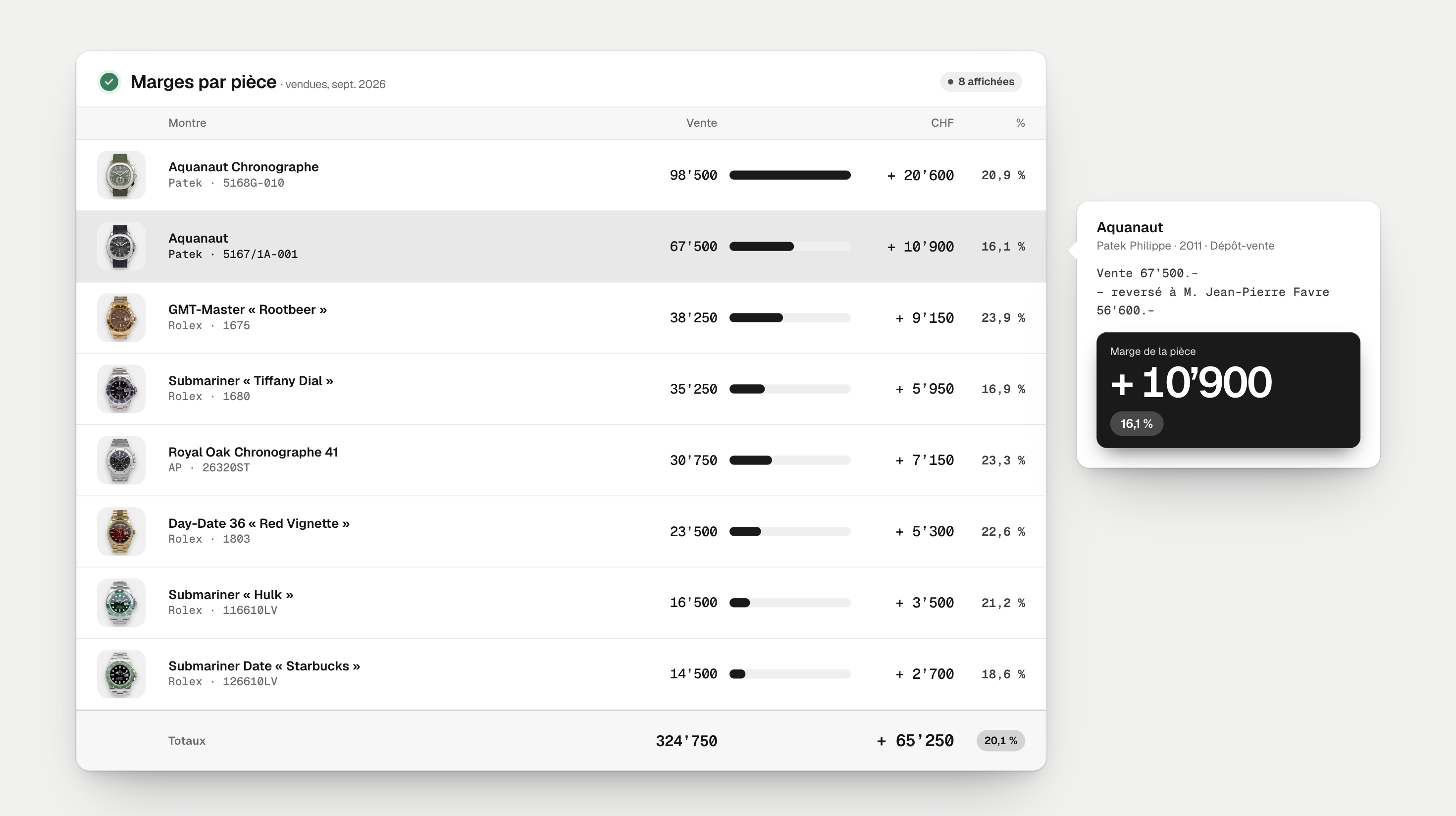
Nobody could say at a glance what the goods in the shop were worth, or the margin made piece by piece, the only one that counts when each has its own purchase price.
Consignment and own stock weren't clearly separated in the accounts either.
The solution
A reference is enough to find and invoice
On arrival, the watch is recorded in Odoo with what makes its value: box, strap, year, original parts or not. Depending on the case, the tool produces a purchase invoice or a consignment document handed to the consignor.
At sale, you just type the reference number: the characteristics fill in the invoice, with the Swiss QR code, and the piece leaves the stock. For a consigned piece, the sale triggers the purchase from the consignor.
Avant / après
Avant
- Tracking on paper
- No known stock value
- No margin calculable piece by piece
- Consignment mixed with own stock
Après
- Each piece recorded with its characteristics
- Stock value up to date, own and consignment
- The margin on each piece, as soon as it's sold
- The two stocks kept separately
Key decision
Why does each watch become a separate product?
A management tool usually thinks in quantities: one item, several copies. That doesn't work here, since two watches of the same model don't have the same value.
So each one creates its own record on arrival, even if it makes the catalogue grow. The only custom developments follow from that: the margin calculated on the object itself, and its characteristics alone carried over to the invoice.
Key decision
Why do the accounts stay with the fiduciary firm?
Ponti Collection invoices in Odoo, but its accounts are kept by a fiduciary firm. So the tool produces its documents in the form the firm expects, and stops there.
Bringing the accounting into it would have added a project, for a task a third party already handles.
Key learning
A switchover date, so as not to keep two inventories
The existing stock was migrated from a template file Ponti filled in, with an announced date: from that day on, the tool is the reference.
Without that date, paper and tool would have kept living side by side, and their two inventories would have gradually drifted apart.
Testimonial
« An invoice now takes me 30 seconds. »
Unique pieces your management tool can't represent? Let's talk.
We start with a conversation, not a quote.
Discuss a similar project