Paying each owner without re-entering anything
The starting point
Managing someone else's property means being accountable to them
Coucou & Co operates homes it doesn't own: an owner hands over the keys, the company takes care of letting, stays and cleaning. Each month, it pays the owner what is due.
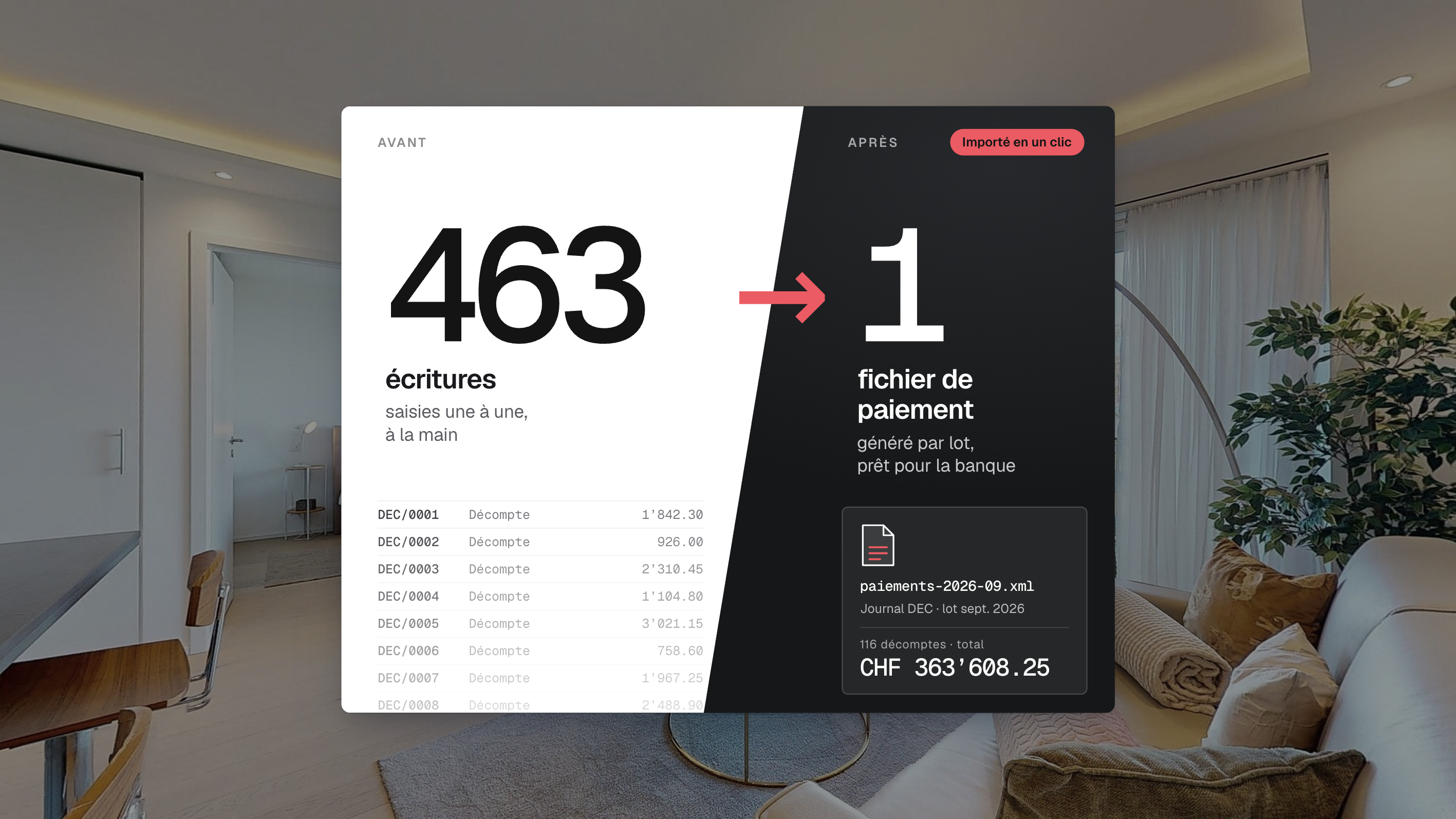
This payment rests on a statement per owner: what their property brought in, what it cost, the balance to pay. It has to be produced, recorded in the accounts of three companies, and the transfer sent.
What it cost
Every statement copied line by line into the accounts
The business platform already produced the statements, and Odoo kept the accounts. In between, the CFO entered each statement by hand, then prepared the payments one by one for the bank.
Management, for its part, re-entered its figures into a spreadsheet every month to produce charts. [The time these entries cost has not been measured.]
The solution
One export, one import, and the accounts are up to date
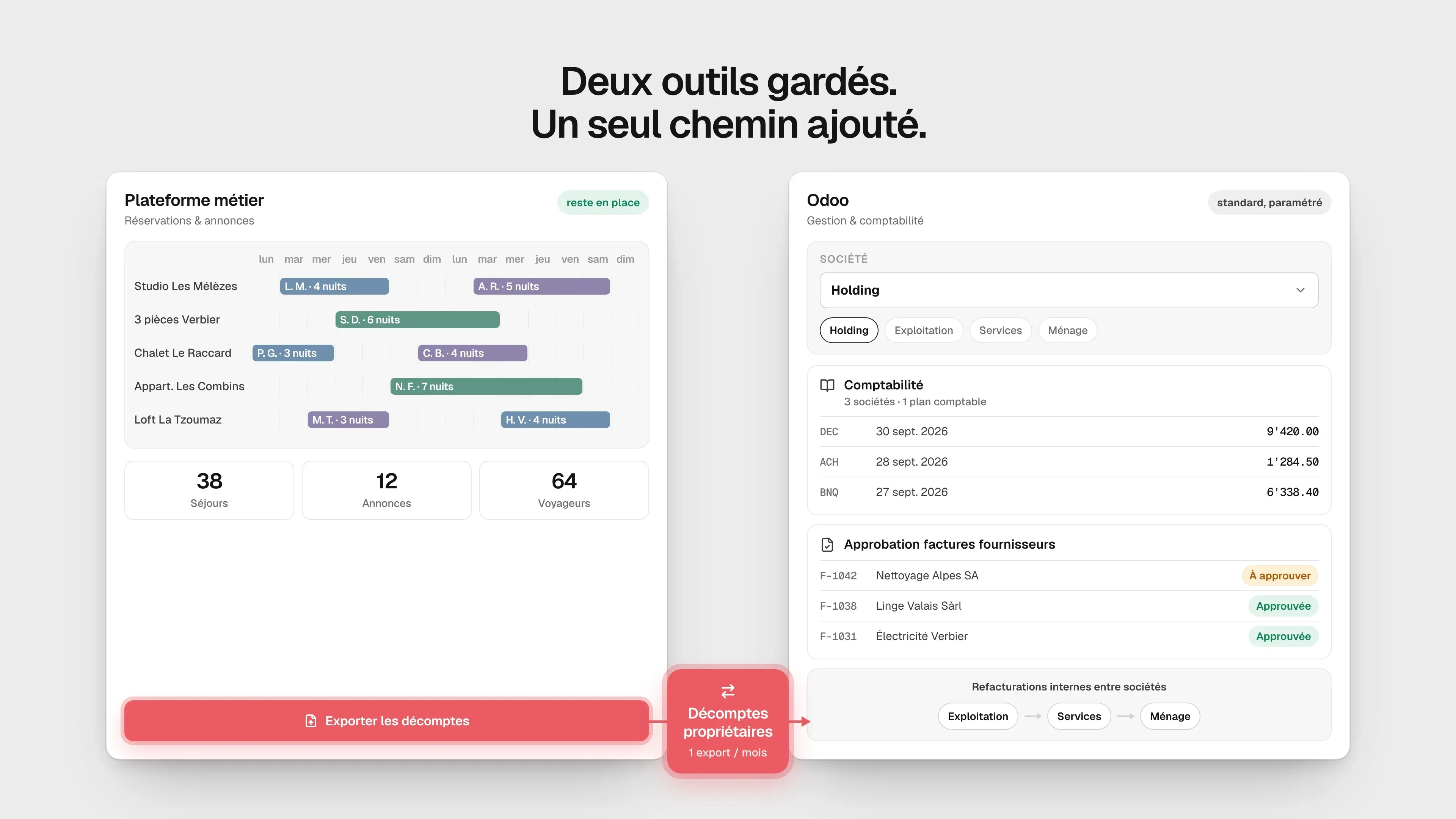
The business platform now outputs all owners' statements at once. Odoo picks them up, posts the entries and generates the payment files in the bank's format: all that's left is to upload them to e-banking.
The three companies, with their intercompany recharges, fit into a single set of accounts, and the dashboards fill themselves from the entries, updated every day.
Avant / après
Avant
- Every entry made by hand, line by line
- Payments prepared one by one
- Dashboards re-entered every month
Après
- Entries posted by the tool
- A payment file ready to upload to the bank
- Dashboards updated every day
Key decision
Why connect the two tools rather than replace one?
The reflex would have been to bring bookings into Odoo, to have a single system. But the business platform knows how to keep a calendar of stays, listings and travellers, and Odoo wouldn't do it better.
So we took over maintenance of this platform, originally built by another provider, and added what was missing: the path to the accounts.
Key learning
The same word meant two opposite gaps
"Owner statement" came up in both of the group's businesses, and it wasn't the same job. Here, the statements existed and it was the accounting that didn't follow; for the same group's aparthotels, it was the opposite.
Same word, same client, two unrelated pieces of work: we don't start from the solution, we first find out which of the two ends is missing.
What comes next
Payroll, then HR management
Payroll is being set up. Leave, expense reports and timesheets will follow, building block by building block, as the needs arise.
The result
- [Figure to be provided: the time entering the accounting entries took the CFO]
Two tools that don't talk to each other, and someone in the middle copying? Let's talk.
We start with a conversation, not a quote.
Discuss a similar project