An acquired company is operational the next day: three to four hours of IT integration, and the group does it itself.
The starting point
A group whose business is buying, and therefore integrating non-stop
The client is a Swiss German group, backed by an investment fund, that buys cleaning companies to build a sizeable player. The model is simple to state: acquire, harmonise management, improve results, repeat.
Which means integrating a company isn't an exceptional project for them: it's a recurring operation. They buy roughly one a month. Every hour saved on this operation is therefore multiplied by the number of acquisitions to come.
And at the start, there was nothing: we arrived at the same time as the model. The need was stated from the outset: being able to absorb a newly bought company quickly.
We work with them in English.
What it cost
Every acquired company arrives with its own chart of accounts
That's the detail that explains everything else. A chart of accounts is the list of a company's accounts: a number, a description. There is a Swiss template for SMEs, but each one adapts it to its business, and the more developed a company is, the more it has customised it. The result: two companies in the same trade don't have the same chart of accounts.
When you buy a company, you therefore inherit its accounts as they are written. And as long as its chart of accounts doesn't resemble the group's, no consolidation makes sense: the figures exist, but they don't speak the same language.
The solution
A foundation where every company speaks the same accounting language
The work wasn't on consolidation itself, which the tool covers as standard. It was on what makes it possible: aligning the charts of accounts of the acquired companies with a common reference chart, since they all do the same business; defining the analytic accounts; and setting the consolidation method, which account rolls up into which.
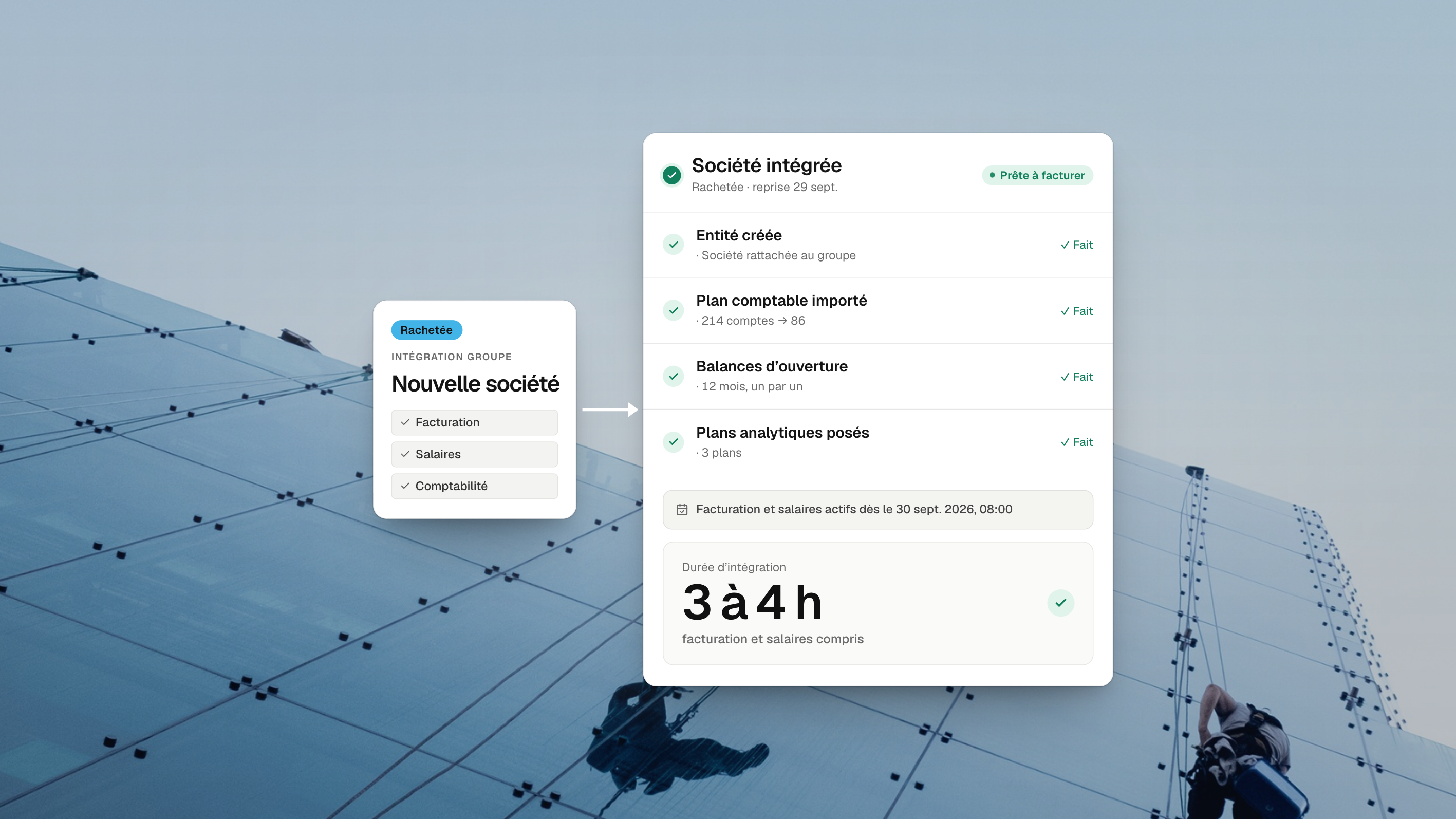
Integrating a company then comes down to a known sequence: create the entity, import the chart of accounts, import the opening balances month by month, set up the analytic plans. Three to four hours. The next day, the company invoices and pays its salaries.
The scope is deliberately tight: contacts, accounting, payroll. Not sales: those are issued from the group's business portal, and on the tool side we built the entry points that let this portal drop its invoices in.
The three to four hours are IT time. On the group's side, there's still training the acquired company's teams and travelling: that takes longer, and it's their job.
Avant / après
Avant
- Every acquired company with its own chart of accounts
- Figures that existed without being comparable
- An integration to redo from scratch with every acquisition
- Consolidation rebuilt after the fact
Après
- A reference chart every company is brought into line with
- Analytic accounts and a consolidation rule set once
- Three to four hours to integrate an acquired company
- A foundation the group replicates itself, without us
Key decision
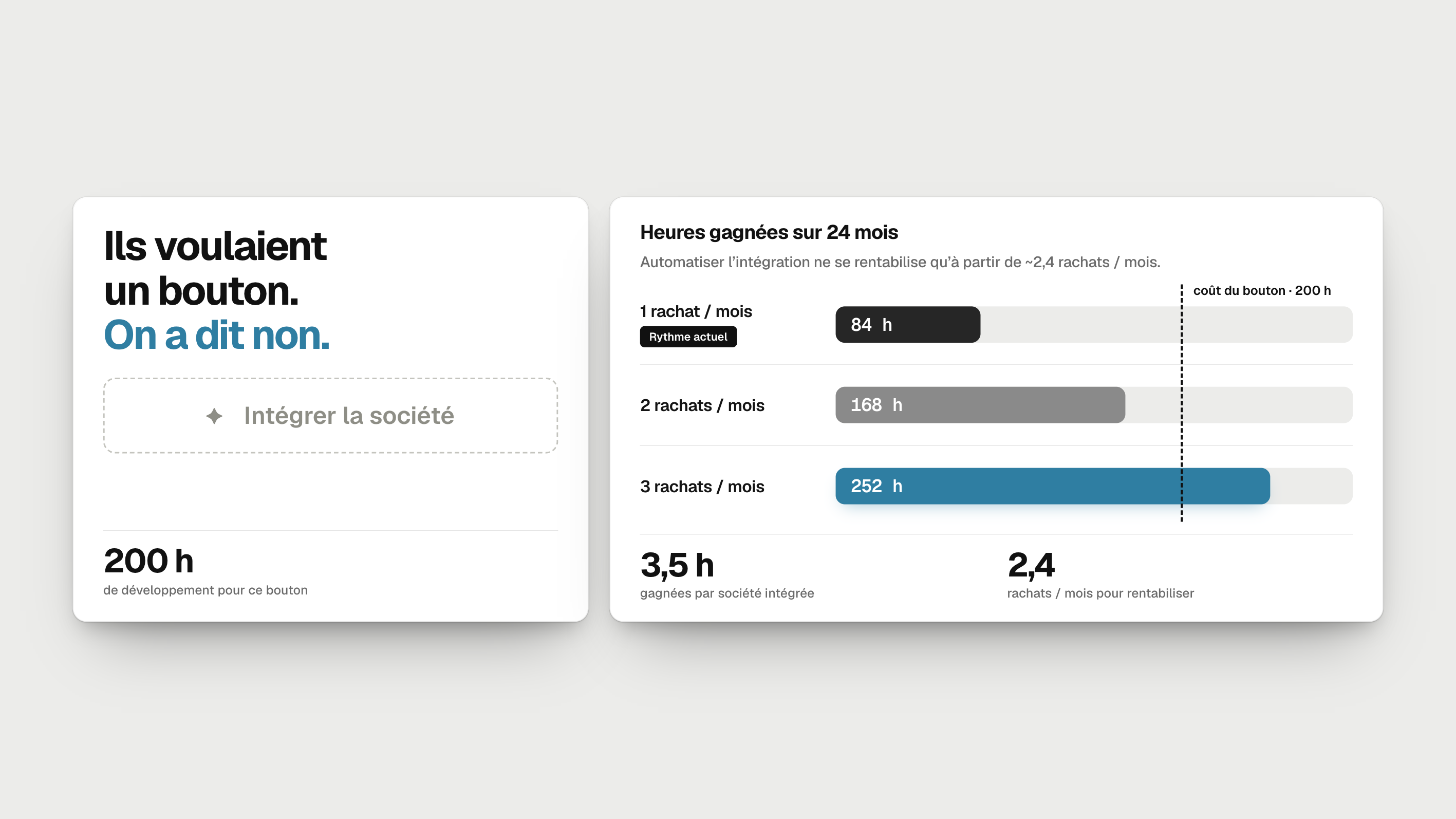
They wanted a button. We said it wasn't worth it.
The request was legitimate and appealing: a single button that would create the company and do everything else, bringing the three to four hours down to a few minutes.
We didn't build it, and we told them so: at the pace of one acquisition a month, automating this flow would cost more to develop than the hours it would save. It would pay off at three acquisitions a month. Not at one.
It's an uncomfortable position to hold: turning down development a client is ready to pay for. But the bill for a useless development always comes back, in the form of a client wondering what they bought. If the pace of acquisitions increases, the maths changes, and we'll do it.
Key decision
Success is measured by our absence
Today, when the group buys a company, it integrates it itself. We no longer step in at this stage: our work is limited to support and new features. This isn't a withdrawal, it's the goal that was reached: the foundation we set up matches the way they work, it's simple to use, and they've learned to reproduce it.
Fourteen companies have gone through it in two years, starting from scratch.
For a client whose business is serial acquisition, a service that remains indispensable for every operation is a cost, not a service. Better to deliver a foundation they make their own than a dependency that gets invoiced.
What comes next
An automatic reader for medical certificates, so salaries come out right
The current project is no longer about integration but payroll: a separate tool that reads sick notes as soon as they arrive, extracts what's needed, and passes it on through a programming interface so the salary is calculated correctly. It's the kind of building block that only makes sense once the foundation is stable: on a patched-together base, it wouldn't hold.
The result
- An acquired company can invoice and pay its salaries from the next day
- Fourteen companies integrated in two years, starting from scratch
- The group runs the integration on its own: we no longer step in
Several companies, one set of accounts to keep? Let's talk.
We start with a conversation, not a quote.
Discuss a similar project